Showing posts with label paper. Show all posts

Sunday, 22 September 2013

Curious Clare's Handmade Wedding - Part One

Bird bunting can be ordered here
Our wedding reception at a local village hall was the perfect venue for this handmade vertical bird bunting. It added a splash of colour to an otherwise tall and dark ceiling. The bunting decorations hung beautifully with tissue paper pompoms and lanterns. 

The bird motif used in the laser cutting is taken from the robin on my Curious Clare logo (see above!). 

I had great fun making this bunting and it looked so pretty hanging above the trestle tables at our wedding reception.


Sunday, 7 July 2013

Goodbye Baby Chip


A personal account of a miscarriage that I have written to help me come to terms with my loss and also to act as a record of a fleeting life.
On Friday 26th April, we discovered that I was five weeks pregnant. We were overjoyed and a little awed at the prospect of welcoming a new member into our little family. All the signs over the next few weeks were of a normal healthy pregnancy and it was becoming increasingly tricky to disguise my growing bump. Little did we know that seven weeks later I would start to miscarry when a scan revealed that the baby did not have a heartbeat. I always knew that a miscarriage was a terrible experience but I had no idea that it would be so painful, prolonged and frightening or end in emergency surgery after two failed attempts at medical management.

Whilst recovering back at home, I struggled to come to terms with the loss. Not only was I in physical pain but I also felt bereft and heartbroken. As the time passed I knew that I needed something tangible to mark the event and acknowledge a life that was never meant to last for long. I began to think about western ways of dealing with death but none of them seemed to be appropriate. Then I remembered the ceremonies that I have witnessed in Japan and Hong Kong. I have always felt an affinity with Buddhist teachings and found their religious ceremonies and temples to be calming.  I realise that religion is not to be dipped in and out of but I really needed a way of acknowledging the fact that I would never get to hold or meet my lost baby.

These thoughts led me to think about the use of paper votives, street shrines (which I have posted about before) and Jizo statues. I first came across Jizo statues in temples and at roadsides when I lived in Japan. I was intrigued to know why certain small statues were adorned with hats and bibs. I later learnt from my Japanese friends that they were used to represent the souls of dead children.
Jizo Statues photo by Al McDermid
Jizo is a Bodhisattva who looks after women, children (including the souls of unborn children) and travellers. Jizo statues are a physical marker of a loss of a child and a protector. They are used in Mizuko Kuyo, which is a Japanese ceremony held in Buddhist temples for those who have had a miscarriage, stillbirth, or abortion. Mizuko beautifully translates as "water child” which for me seems a really fitting description of a lost baby. 

After thinking about these traditions, I decided that I wanted to create a paper offering that could be released as a simple farewell. I settled on the idea of an origami boat which would be set free by the action of it floating down a gentle stream at Dunham Massey, one of our favourite places. I printed off my favourite wedding photo (that has myself, my husband and son on it) and wrote a letter to baby Chip from all of us before folding it up into a paper boat. I later added 4x sails to symbolise each one of us, with the largest sail representing baby Chip. We floated the boat away the other evening and as time is passing I feel physically better and now hope that the act of saying goodbye will help my emotional healing.
Goodbye baby Chip. 

Tuesday, 15 January 2013

The First Cut – Students’ Responses

The teacher’s preview evening of ‘The First Cut’ exhibition at Manchester Art Gallery included the opportunity to work with artists Nicola Dale and Andrew Singleton. Initially, the artists gave us an overview of their work to date and afterwards delivered workshops where they shared their secrets with us!
  This proved to be great fun and it was beneficial to us all as educators to be in the position of a learner for a change! I enjoyed the workshops so much that I took the ideas back to school and challenged my Year 12 students to take Nicola and Andrew’s ideas on board. Students were shown the artists’ work and after a demonstration were asked to work in small teams to explore the qualities of paper. 
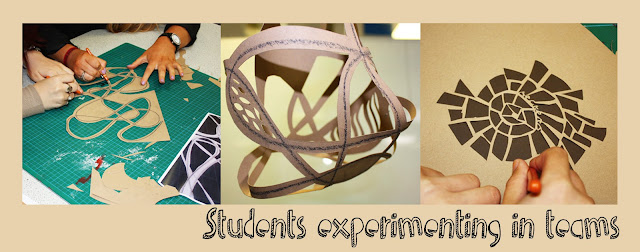
Students initially experimented with different techniques ranging from piercing and slicing to rolling and wrapping. They were then asked to use the best of their ideas to create a group piece that could be hung in the style of Andrew Singleton. Their homework task was to take an old Manchester Art Gallery guide and create a small sculpture from it, as Nicola had asked us to do during her workshop. They were given the theme of water as the old guide was for a watercolour exhibition. One of the results of this task can be seen below. 
  It is interesting to see that this paper workshop and exhibition are still influencing students today as they work towards their final submission for Unit 3. I look forward to seeing the end results and would like to say a big thank you to Manchester Art Gallery, Nicola and Andrew for delivering such an inspirational session back in July.

Saturday, 5 January 2013

The First Cut

The First Cut exhibition at Manchester Art Gallery is a stunning celebration of artists who use paper in original and exciting ways. There has been a growing trend of artists cutting and sculpting paper over the past few years and this exhibition brings together some of the most important names in one place. 

I was fortunate enough to be invited to a teacher’s preview evening in July where we found out about the concept of the exhibition and worked with two of the exhibiting artists – Nicola Dale and Andrew Singleton. As I am a such a huge fan of cut paper work (whether it has been cut by hand or by laser), it was a real treat to be able to work with Nicola and Andrew. Both artists took time to carefully explain the influences behind their sculptures before showing us their working methods. For me, it is really important to know how a work of art has come about as it places the work in context and becomes much more meaningful.
Watch a short interview with Andrew here
Watch a short interview with Nicola here

Paper sculptures in ‘The First Cut’ are dotted all over Manchester Art Gallery but the main exhibition area is on the top floor where artists have got the advantage of the vast rooms to display their creations. Walking in to the first room, I was immediately greeted with the surreal hanging sculptures of Manabu Hangai. Manabu’s ‘Wonder Forest’ is a series of enormous tree like sculptures that are suspended from the ceiling. As I wandered through his gently moving forest it conjured up feelings of being a child again. Manabu has created the installation from locally sourced branches and autumnal coloured leaves made from Japanese seaweed. The leaves are made from ‘hosojuzumo’ which is a seaweed based raw hemp paper pigment native to Hokkaido, Japan. The leaves have a lovely lace like quality to them and cast beautifully patterned shadows on to the floor as they slowly move around. Magical!

I was also thrilled to see two of my favourite paper artists in the first room, Rob Ryan and Peter Callesen. The scale of both artists’ work surprised me. Rob’s work was cut on a much larger scale than I had imagined it would be and Peter’s work was exceptionally small (being fashioned from a single sheet of A4 paper). It just goes to show the importance of seeing art work first hand (Year 13 take note!)
Claire Brewster has cut birds on display in the main exhibition area and butterflies on the first floor in the Pre-Raphaelites gallery. Here, on the dusky turquoise walls and amongst work of another time, she has pinned exquisitely cut butterflies. Claire has used vintage map paper to create the butterflies which range in size and shape – some look like they are resting whilst others are in flight. I like the reference that she has made here to the Victorian’s act of pinning and classifying nature.

There are many other equally talented and interesting artists in this exhibition – far too many to mention in this post! You can see a great clip of the exhibition installation here. If you are in the area, it is well worth a visit. The exhibition is on at Manchester Art Gallery until Sunday 27th January 2013 before moving on to Djanogly Art Gallery in Nottingham (from April).


Monday, 3 December 2012

Votive Paper People

Whilst in Hong Kong, we stumbled across some intriguing small shops that were packed to the rafters with paper products. These items were all intended to be burnt as offerings to the dead. The paper products ranged from bundles of gold stamped paper and fake paper money to three dimensional paper cars, houses, clothes and people. They even sold paper iPads and paper laptops! We ended up buying a paper boy and girl dressed in their pyjamas. I couldn’t bear the thought of such lovely objects going up in smoke.
Worshippers usually visit temples or shrines to cast their votive objects into an open fire. However, in Hong Kong we witnessed these acts of worship on the street, amidst the hustle and bustle of every day life. In one area, several ladies had set up make shift shrines underneath a busy underpass where buses and trams trundled by. The burning of paper tigers seemed to be popular here. Most markets also had a small metal container where people could burn sheets of paper. This to me seemed like a fast food approach to religion!

The burning of paper is a Buddhist tradition practised in China, Vietnam and Korea. The paper items, or votives, are ceremonially burnt during festivals. The main time to burn these votive objects is during the seventh lunar month and a week before the Lunar New Year, also known as Tết Nguyên Đán. The intention is to commemorate the dead and send the votive objects to their dead ancestors. Some people hope that by doing this, their dead ancestors will be pleased and in return help them out in their business dealings or health. Funerals are another occasion when paper is burnt and this is usually in the form of fake paper money.